The access methods, compared
| Method | What it is for | The cost that comes with it |
|---|---|---|
| Under-bridge inspection unit (snooper truck) | Hands-on access under the deck from above | Unit hire plus traffic control and lane closures; scheduling around peak traffic |
| Rope access | Hands-on work: testing, sampling, repairs at height | Crew day rates, exclusion zones, working-at-height exposure; compared in detail in our access methods cost guide |
| EWP or scaffold | Hands-on work within reach of ground or deck | Hire, permits, set-up time; limited reach under long spans and over water |
| Boat or barge | Piers and soffits over navigable water | Marine plant, weather windows, slow coverage |
| Drone (close visual inspection) | The visual layer: systematic imagery of every visible face | A pilot, a flight plan and the airspace approvals; nobody leaves the ground |
The split that works in practice: the drone owns the visual layer, and hands go up only where a finding demands hands. Testing, sampling and repair still need rope crews or an EWP, but they mobilise to specific, photographed, located defects instead of searching the whole structure. Fly first, then send people to exactly the places that need people.
There is published cost evidence for the pattern. A 2025 Monte Carlo cost model built on US state transport department data (Askarzadeh and Bridgelall, Infrastructures 10(3):63) put the median cost of a drone-based bridge condition inspection at US$1,770 against US$7,216 for traditional methods, and found the drone's higher set-up cost is not recovered on the first inspection, only over repeat cycles. Different country, different labour rates, same shape: the saving is in access and closures, and it compounds with repetition.
What the drone delivers
Not a video someone scrubs through once. A close visual inspection is delivered as an itemised defect register: every visible face captured systematically, and each item carrying an ID, the element it sits on, a plain description of what is visible, its location on the structure, a wide context frame and a tele detail frame from the same hover position, and a laser-rangefinder position for the defect surface so it can be found and re-shot on the next cycle. Descriptions stay descriptive. Classification, assessment and sign-off stay with the engineer, who now has the whole structure in front of them in order and in resolution.
Where the job needs measurement as well as imagery, the same capture feeds photogrammetry and AI defect detection: cracking, spalling and corrosion staining detected across the capture, pinned to a measurable 3D model and verified by hand before anything is issued. In a controlled AI defect detection trial on a concrete culvert under the M1 at Tingalpa, cracking was detected from 0.2 mm, finer than a ground-level visual pass reliably catches.
Two Brisbane bridges, two real constraints
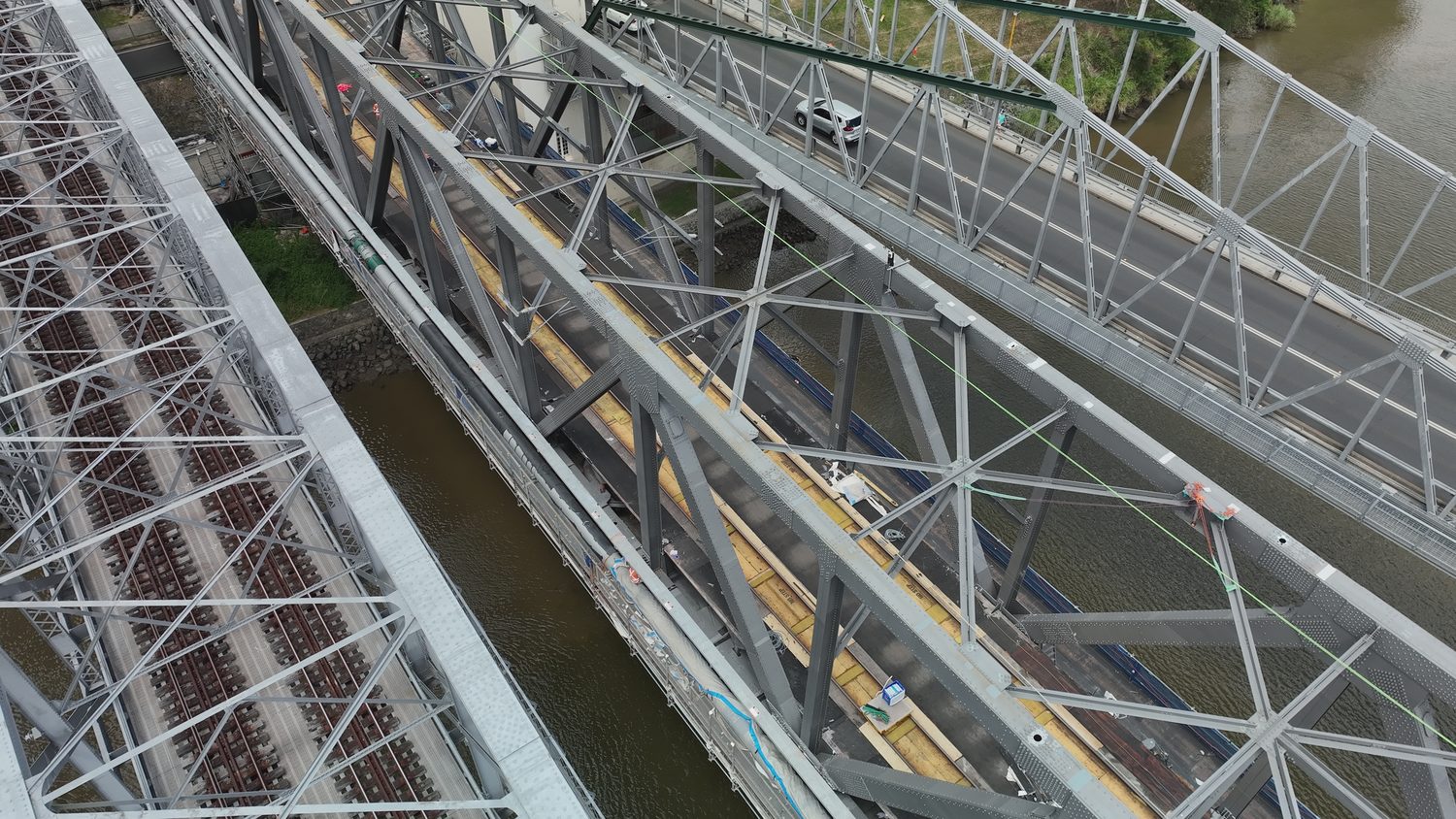
Indooroopilly Rail Bridge. A remediation inspection flown concurrently with a Queensland Rail weekend track possession, with a live HD relay to the supervisors on the bridge, so repair crews and inspection never competed for possession time. In rail corridors, possession windows are the scarcest resource on the project; an inspection method that does not consume them changes the schedule. The Indooroopilly case study has the detail.
Story Bridge. After Riverfire 2025, the under-deck debris netting needed verification with the bridge's own under-deck platforms out of action. Close visual capture confirmed the netting intact, reviewed live with the contractor over video, with no access equipment remobilised and no stand-down of the works below. The Story Bridge case study covers how it ran.
Different owners, different structures, same pattern: the constraint was access, and removing it was the value.
Queensland specifics worth knowing
- Airspace. Much of urban Brisbane sits in controlled airspace. Hover operates under CASA ReOC #9398; routine controlled-airspace work clears through the automated airspace authorisation service, which is open to ReOC holders only, and non-standard operations such as flying over people, above 120 m or inside restricted airspace need a CASA Form 101-09 lodged at least 60 days ahead. The CASA regulations explainer sets out both paths.
- Rail corridors. Flying near live rail means the corridor owner's processes come first: possessions, protection arrangements and a flight request lodged ahead of time. Hover has worked inside them at Indooroopilly and on the Burnett River rail bridge at Bundaberg; plan the paperwork lead time into the program.
- Water. River crossings mean wind over water and tidal working windows for any marine alternative. The drone needs a weather window too, but not a tide, and no barge is on hire while you wait for it.
- Documentation. JSA, insurances ($28M public liability) and operating certificates are supplied ahead of mobilisation as standard, with a SWMS where the site requires one.
What it costs
Bridge and major-structure inspections typically start from around $2,000 excluding GST, scaling with structure size and the depth of the register. Against under-bridge unit hire plus traffic control, or a multi-day rope program, the visual layer by drone is usually the cheapest part of the whole inspection budget. The bands and the five factors that move them are in the cost guide, and drone inspections in Brisbane sets out the operating area and the structures covered. A written fixed quote comes back within one business day.
Common questions
Q/01Does the bridge need to close for a drone inspection?
For the drone capture itself, almost never: flight is from standoff and the structure stays in service. Rail corridors are the exception, where the work fits the corridor owner's possession and protection arrangements, as it did at Indooroopilly and at Bundaberg.
Q/02Can a drone inspect the underside of a deck?
Yes. Under-deck soffits, bearing shelves and truss interiors are where drone access earns its keep, as the Story Bridge netting verification showed. Where the geometry is tight, standoff and lens selection are designed around it in the flight plan.
Q/03Does this replace rope access or an EWP?
It replaces them for the visual layer. The moment a finding needs hands, for testing, sampling or repair, rope or EWP crews mobilise to that specific location with the frames in hand. The full cost comparison across the three methods is in our drone inspection versus rope access versus EWP guide.
Q/04What do we receive from a drone bridge inspection?
An itemised defect register covering every visible face: ID, element, plain description, location, a wide and a tele frame from the same hover position, and a laser-rangefinder position per item. Live relay during the flight where your engineer wants eyes on it in real time, and, where scoped, AI defect detection pinned to a measurable 3D model.
Q/05How fine a defect can it pick up?
In a controlled AI defect detection trial on a concrete culvert under the M1 at Tingalpa, cracking was detected from 0.2 mm. Capture resolution is set per job in the flight plan, and detection is not the same as width measurement, which still needs a gauge on the structure.