For most visual inspections of bridges, towers, facades and roofs in Brisbane, a drone is the fastest and lowest-cost way to get inspection-grade imagery, typically a few hundred to a few thousand dollars per structure, with nobody working at height. Rope access and elevated work platforms (EWPs) still matter, because when someone has to physically touch the structure — torque a bolt, sound concrete, take a sample, make a repair — the access equipment is the job, not the inspection. This guide compares the three honestly: what each costs in 2026, what each is actually for, and the hybrid pattern that gets asset owners the best of both.
Cost, safety and access at a glance
Indicative 2026 Brisbane market figures; every real job is scoped on the asset, the access and the deliverable.
| Drone (close visual inspection) | Rope access | EWP / underbridge unit | |
|---|---|---|---|
| Indicative Brisbane cost (2026) | From a few hundred dollars to low thousands per structure | ~$3,000–$6,000+ a day for a certified crew | ~$1,500–$3,500+ a day hire plus operator; traffic control extra |
| People working at height | None — pilot stays on the ground | Two-person minimum on ropes | Crew in the basket, often over live traffic or water |
| Set-up and disruption | Minutes; no closures for most structures | Anchor rigging, exclusion zones, rescue plan | Lane closures or possessions commonly required |
| Reach | Under-decks, mid-spans, tower heads — anywhere with line of sight | Anywhere riggable, slowly | Limited by boom envelope and ground access |
| What you get | Geolocated, repeatable high-resolution imagery, reviewed live or after capture | The inspector's eyes and hands on the structure | The inspector's eyes and hands on the structure |
| Where it loses | Can't touch, test or repair | Cost, speed, working-at-height exposure | Access footprint, closures, hire cost |
Where a drone inspection wins
Condition monitoring, defect documentation, post-event verification, and screening large structures so access crews are only mobilised to the spots that need hands. High-resolution zoom capture from a safe standoff resolves surface detail comparable to a hands-on inspection at arm's length, and every image is geolocated and repeatable — the next inspection cycle photographs the same faces the same way, so change is measurable rather than anecdotal. It's the method behind Hover's close visual inspection service and the drone inspection programs we fly across Brisbane and South East Queensland.
Where rope access and EWPs still win
Anything tactile: sounding, materials testing, sampling, torque checks, repairs. A drone tells you where to put people on the structure; it doesn't replace putting them there when the finding demands hands. If the scope is "fix it while you're up there", rope access or an EWP isn't a cost to eliminate; it's the point of the exercise.
Fly first, then send people: the hybrid pattern
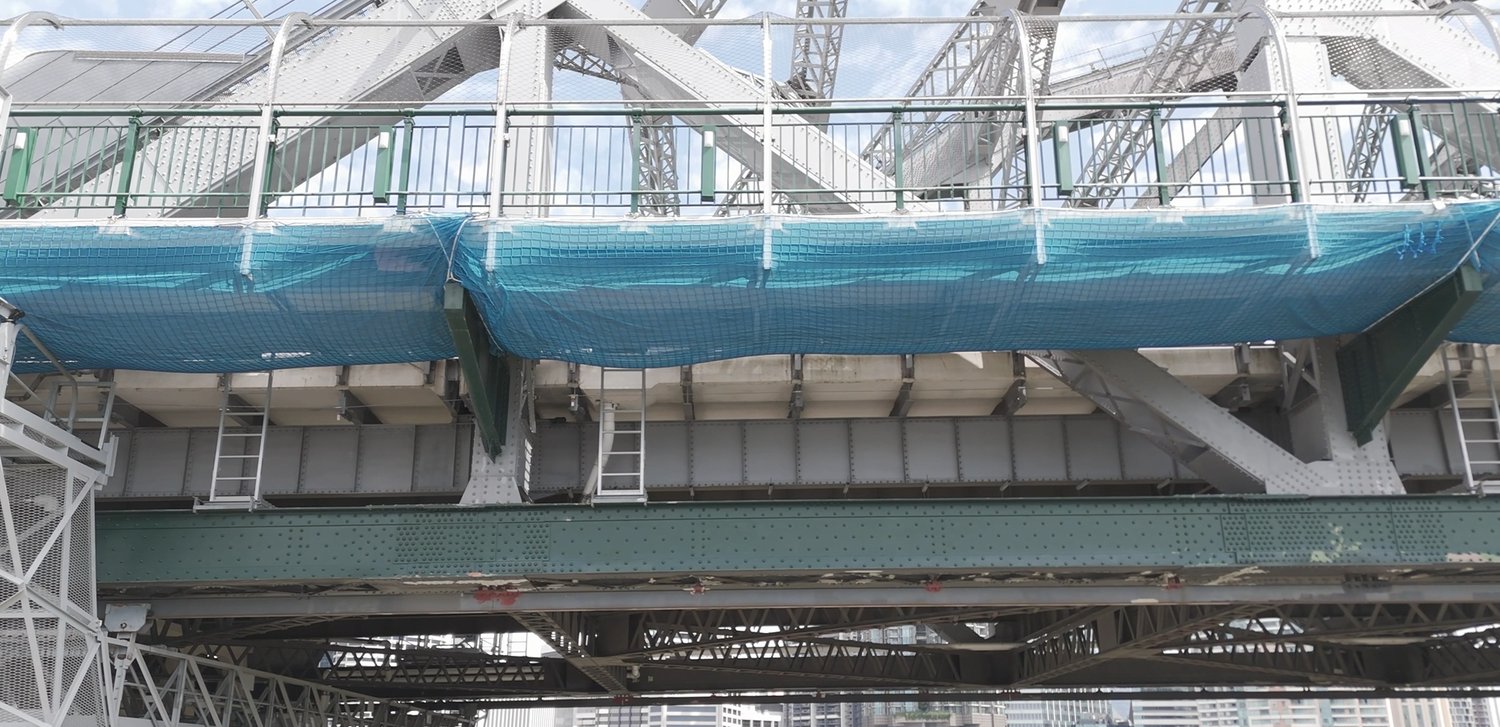
The pattern we see on real Brisbane jobs is sequencing, not substitution: fly the structure first, verify condition, then mobilise access equipment only where a finding requires hands-on work. When the Story Bridge's under-deck inspection platforms were out of service and its debris netting needed verifying after Riverfire 2025, a drone close visual inspection answered the actual question — is the netting intact? — in a live video review with the contractor, without remobilising any access equipment. Read the Story Bridge netting verification case study.
What moves the price
The ranges above are wide because four things move every quote: airspace (CBD and near-airport work needs CASA approvals, which Hover arranges as standard), access windows and possessions, structure complexity, and deliverable depth, since a referenced photo set costs less than AI defect detection geolocated on a 3D model. The drone survey and inspection cost guide breaks the full pricing picture down; for a real number, Hover returns a written fixed quote within one business day.
Common questions
Q/01How much cheaper is a drone inspection than rope access in Brisbane?
For a purely visual inspection, routinely a fraction of the cost. A single structure inspected by drone typically runs from a few hundred dollars to the low thousands, against roughly $3,000–$6,000+ a day for a certified rope-access crew, before rescue planning, exclusion zones and standby time are added. These are indicative 2026 market figures; every job is scoped and quoted in writing.
Q/02Can a drone inspection fully replace rope access?
No, and an operator who claims it can is overselling. A drone replaces the looking: coverage, documentation and condition monitoring. It can't torque a bolt, sound concrete, take a sample or make a repair. The efficient model is drone screening first, targeted hands-on access second — so access crews are only mobilised to the locations that actually need them.
Q/03Do I need road or lane closures for a drone inspection?
Usually not, and on bridge and facade work that's often the single biggest saving. An EWP or underbridge unit typically forces lane closures or possessions the drone doesn't need, because the aircraft works from a safe standoff rather than occupying the carriageway. Where controlled airspace applies, Hover arranges the CASA approvals ahead of mobilisation.
Q/04Are drone inspection records suitable for engineering inspection programs?
The imagery is geolocated, time-stamped and repeatable, reviewed by your inspector live or after capture, and delivered as a referenced record that is widely used for routine visual inspection cycles, condition monitoring and post-event verification. Where a regime mandates hands-on testing, the drone doesn't replace it; it directs it to the right locations.